

By Hans Thore Smedbold1,2
1Norwegian University of Science and Technology, Faculty of Medicine and Health Sciences, Department of Public Health and Nursing. hans.t.smedbold@ntnu.no
2St. Olavs Hospital, Trondheim University Hospital, Clinic of Thoracic and Occupational Medicine
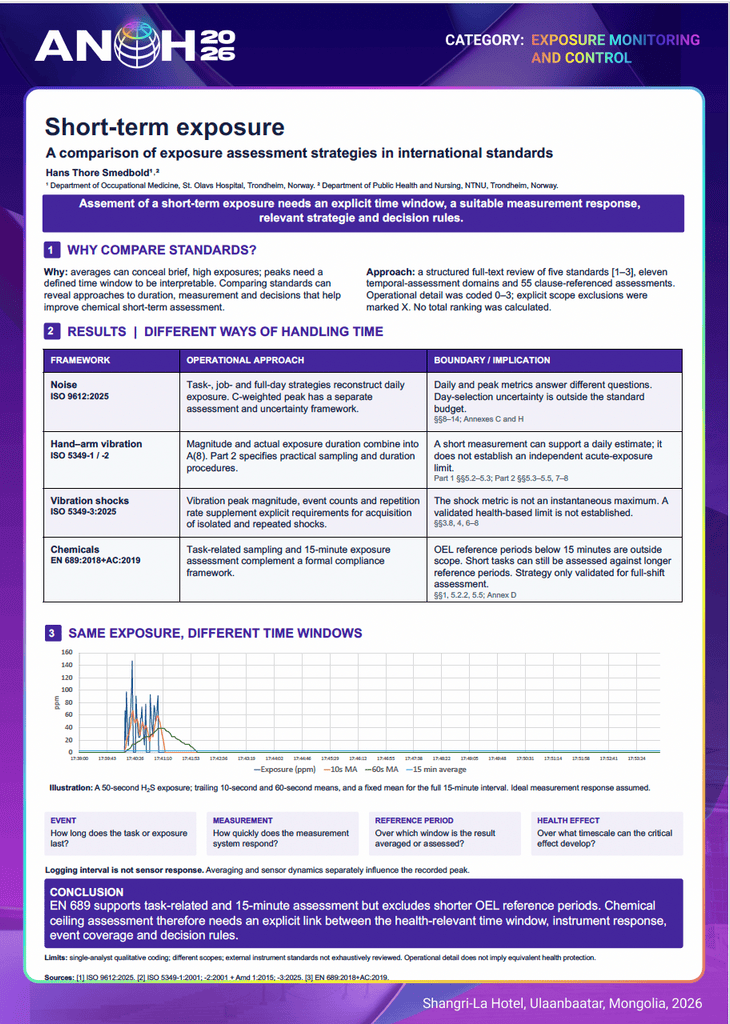
Occupational exposure assessment is commonly based on full-shift average exposure, while many clinically important exposures occur as short-duration tasks, transient peaks or episodic events. This creates uncertainty when assessing agents with acute irritant or toxic effects.
The aim of this study was to compare how selected international standards describe sampling strategies, reference periods and interpretation of full-shift, short-term and peak exposure. A structured comparison of standards for occupational noise exposure, vibration and exposure to inhalation to chemical agents, focusing on reference period, sampling strategy, task duration, statistical decision rules and handling of short-term or peak exposure will be presented.
ISO 9612 provides explicit task-based, job-based and full-day measurement strategies, allowing short task measurements to contribute to full-shift exposure estimates. EN 689 provides a structured framework for assessing inhalation exposure against occupational exposure limits, but gives limited operational guidance for short-duration tasks, episodic peaks and ceiling-value assessment.
This difference is important for chemical exposures where short peaks may be clinically relevant independent of the full-shift average, such as hydrogen sulphide, chlorine dioxide and other irritant gases. Traditional full-shift strategies may underestimate relevant risk, while single maximum values may overstate risk if instrument response, logging interval and toxicological reference period are not considered. The relevance to short-term exposure might also expand to other agents as allergens as well.
Improved guidance is needed for assessing short-term and peak chemical exposure, including reference periods, direct-reading instruments, uncertainty and clinical relevance.
Printable pdf of poster presented at ANOH 2026
Keywords: short-term exposure; peak exposure; ceiling value; EN 689; ISO 9612; ISO 5349, occupational hygiene
